
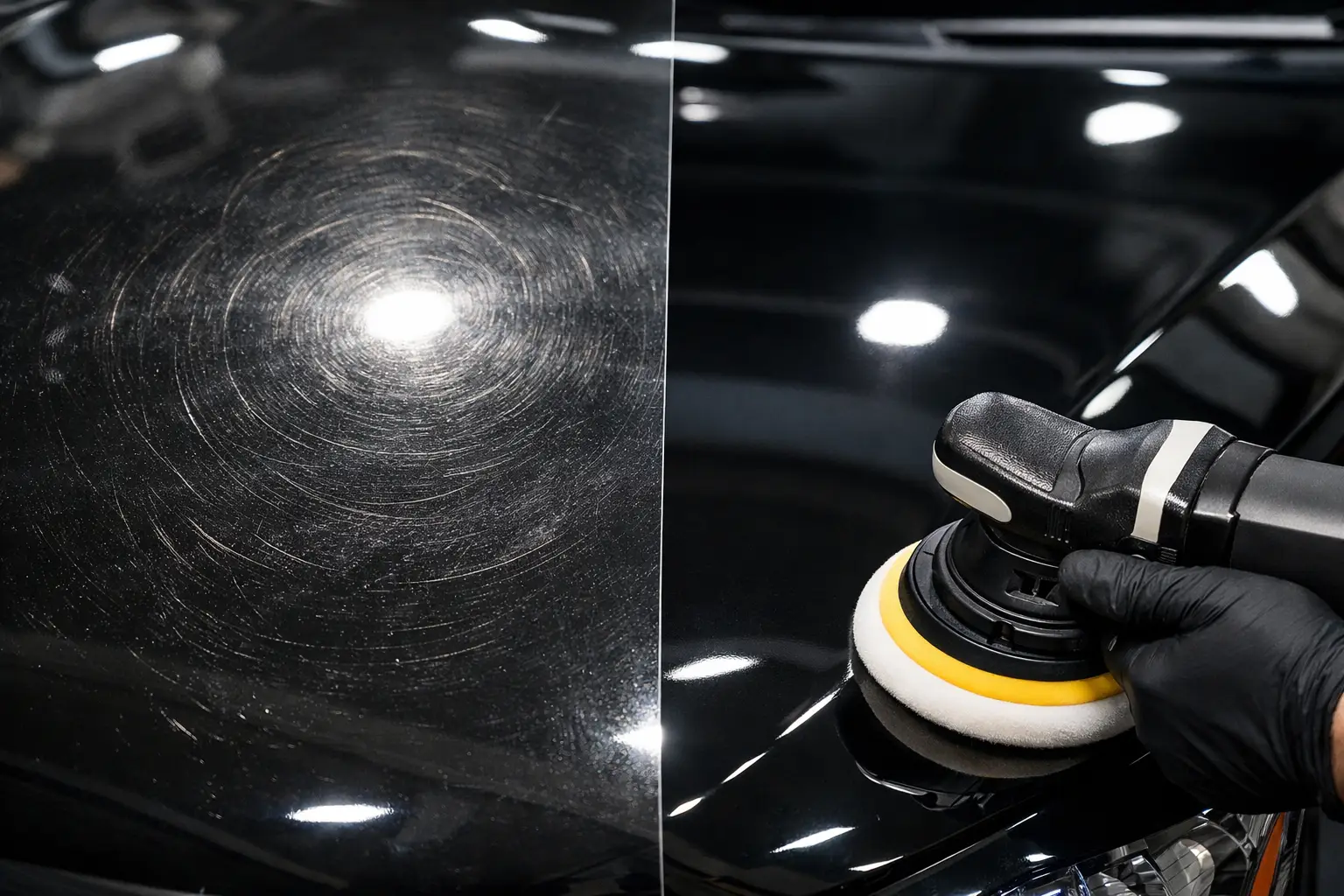
That cloudy spiderweb effect you notice under garage lighting or direct sun is usually the first sign your paint is losing the crisp, deep gloss it should have. Paint correction swirl marks are one of the most common issues we see on daily drivers, luxury vehicles, and even newer cars that have only been through a few improper washes. They make clean paint look tired, and they tend to stand out even more on black, gray, blue, and other darker finishes.
The frustrating part is that swirl marks often show up even when an owner is trying to take good care of the vehicle. A quick tunnel wash, a dirty wash mitt, aggressive drying, or rushed dealership prep can leave behind fine circular scratches in the clear coat. The paint may still be protected to some degree, but it no longer reflects light evenly. That is why the finish starts to look hazy instead of sharp.
What paint correction swirl marks actually are
Swirl marks are not usually deep gouges in the paint itself. In most cases, they are very fine scratches in the clear coat, which is the transparent top layer over your vehicle’s color. When that surface becomes uneven, light scatters instead of reflecting cleanly. What you see is reduced clarity, muted depth, and a finish that looks older than it should.
This is where paint correction comes in. Paint correction is the process of leveling or refining the clear coat through machine polishing to reduce or remove those defects. The goal is not to hide them temporarily. The goal is to restore gloss and clarity by actually correcting the surface.
That distinction matters. Some products fill swirl marks for a few weeks. They can make the paint look better for a short time, but once the fillers wash away, the defects come back. True correction is more precise and more durable because the improvement is in the paint surface itself.
Why swirl marks happen so easily
Most swirl marks come from friction combined with contamination. If dirt is sitting on the paint and that dirt gets dragged across the surface, it behaves like sandpaper. The scratches may be microscopic, but enough of them together create that familiar webbing effect.
Automatic car washes are a frequent cause, especially brush-style systems. Those brushes pick up debris from every vehicle ahead of yours and can grind it into the finish. Hand washing can also create swirl marks if the towels are low quality, the wash media is not rinsed properly, or the paint is dried without enough lubrication.
There are other causes too. Improper snow removal, dusty wipe-downs, body shop sanding marks, dealership prep, and even leaning against the paint with a jacket zipper can contribute. On some softer paint systems, defects happen faster than owners expect. On harder clear coats, the swirls may take longer to build, but once they do, they still impact gloss.
When polishing fixes the problem and when it doesn’t
Most paint correction swirl marks can be improved significantly, and many can be fully removed, but not every defect has the same depth. Light wash marring and moderate swirls generally respond well to polishing. Deeper random scratches may improve without disappearing completely if removing them fully would require taking too much clear coat.
That is why a proper inspection matters. Under strong lighting, a trained detailer can tell the difference between light surface marring, heavier buffer trails, oxidation, etched water spots, and deeper defects that go beyond a safe correction range. A one-step polish may be enough for a vehicle that mainly needs gloss restored. A two-step correction may be the better choice when the paint has more serious swirl buildup and haze.
It depends on the vehicle, the paint type, the color, and the owner’s expectations. Some clients want a major visual improvement on a commuter vehicle. Others want a near-showroom finish on a weekend car or exotic. Both are valid goals, but they require different levels of correction.
How paint correction removes swirl marks
Paint correction is a controlled process, not just buffing the vehicle until it looks shiny. The vehicle is first washed and decontaminated so bonded contaminants are not dragged across the paint during polishing. In many cases, that includes chemical decontamination and a clay treatment to create a clean polishing surface.
After that, the paint is evaluated under proper lighting. Test spots are often used to determine the right pad, polish, and machine combination. This is one of the most important parts of the process because every paint system reacts differently. The right setup for a hard German clear coat may not be ideal for a softer Japanese finish.
Once the combination is dialed in, the paint is machine polished section by section. Depending on the condition, the process may involve a cutting step to remove heavier defects followed by a refining step to increase clarity and gloss. The finish is then wiped down and rechecked so the results are based on actual correction, not temporary filling.
When done correctly, the improvement is immediate. Reflections look sharper. Metallic flake becomes more visible. Dark colors regain depth. The vehicle simply looks cleaner, richer, and better cared for.
Why DIY swirl mark removal often falls short
Consumer polishers and over-the-counter compounds have made DIY paint correction more accessible, but swirl removal still has a learning curve. The biggest mistake is assuming all scratches can be polished out with enough effort. The second biggest mistake is using an aggressive combination without understanding paint thickness, pad choice, heat, or finish quality.
A DIY attempt can improve the paint, but it can also leave behind haze, uneven polishing, missed defects, or new micro-marring. On darker vehicles, especially black paint, those issues are easy to spot. It is also common for owners to chase deeper scratches too aggressively and remove more clear coat than necessary.
For someone with the right tools, lighting, patience, and technique, minor correction at home can make sense. For higher-end vehicles, softer paint, or finishes with noticeable swirl damage, professional correction is usually the safer and more effective option. The difference is not just defect removal. It is consistency across the full vehicle.
Should you add ceramic coating after paint correction swirl marks are removed?
In many cases, yes. Once swirl marks are corrected, the paint is in its best visual condition, which makes it the ideal time to protect it. A ceramic coating helps preserve that freshly corrected finish by adding a durable sacrificial layer that improves water behavior, makes maintenance easier, and reduces the chance of premature degradation from environmental exposure.
What a coating does not do is make the car scratch-proof. That is a common misunderstanding. A ceramic coating will not stop improper washing from creating new swirl marks. It can help with maintenance and long-term preservation, but good wash habits still matter.
For owners who want the best long-term value, correction followed by a quality coating is often the smartest pairing. You restore the appearance first, then protect the result. For vehicles in the Chicago area that deal with seasonal grime, road salt residue, and frequent weather swings, that combination can make a real difference in how the finish holds up between details.
How to keep swirl marks from coming back
After correction, maintenance becomes the deciding factor. If the vehicle goes right back through harsh automatic washes, the paint will start collecting defects again. Maybe not overnight, but much sooner than most owners expect.
The better approach is simple and consistent. Use careful hand washing, clean microfiber towels, proper drying methods, and quality maintenance products. If that sounds like more time than your schedule allows, routine professional maintenance is often the easiest way to protect your investment without compromising convenience.
A well-maintained vehicle does not need major correction as often. That saves clear coat, keeps gloss at a higher level year-round, and protects resale appeal. For busy professionals and families, that is usually the real benefit – not just a nicer shine for one weekend, but a finish that stays noticeably better over time.
Is paint correction worth it?
If swirl marks are making the vehicle look dull, older, or poorly maintained, paint correction is usually worth serious consideration. It restores visual clarity in a way waxes and quick-detail sprays cannot. It can also change how you feel about the vehicle every time you walk up to it.
The value depends on your goals. If you are preparing for a sale, it can improve presentation and perceived condition. If you plan to keep the vehicle long term, it helps preserve pride of ownership. If you drive a luxury or enthusiast vehicle, correction brings the finish closer to the standard the vehicle deserves.
Good paint has depth, sharpness, and a clean reflection. When swirl marks take that away, the entire vehicle looks less refined. Correcting them is not about chasing perfection for the sake of it. It is about bringing the finish back to a level that looks properly cared for, protected, and premium.
If your paint looks glossy in the shade but rough in the sun, that is usually your answer. The finish is asking for more than a wash.
